
What is Freight Factoring?
Freight factoring is the practice of selling your unpaid freight invoices to a factoring company at a small discount in exchange for immediate cash — typically within 24 hours of delivering a load. Instead of waiting 30 to 90 days for a freight broker or shipper to pay, you submit your bill of lading, proof of delivery, and rate confirmation to the factoring company, and they deposit the funds into your account — minus their fee.
Key Takeaways
- Freight factoring turns 30-to-90-day broker payment terms into same-day or next-day cash by selling your invoices to a factoring company.
- Typical factoring rates run 1% to 5% of invoice value, with the factoring company advancing roughly 90-97% upfront and releasing the reserve once the broker pays.
- Approval is based mainly on the credit of the brokers you haul for, not your own credit history, making it accessible to new carriers and owner-operators.
- Recourse factoring is cheaper but leaves you owing the money back if the broker does not pay; non-recourse costs 0.5-1% more and usually covers only broker bankruptcy or insolvency.
- Clean paperwork (rate confirmation, signed bill of lading, and proof of delivery) is required to get funded, and the cheapest advertised rate often hides extra fees, so compare total cost.
Ahmad Qazi
Founder & CEO, O Trucking LLC
Fact-Checked by O Trucking Dispatch Team
5+ years helping carriers manage cash flow, factoring relationships, and broker payment verification
Written by Ahmad Qazi, founder of O Trucking LLC, drawing on 9+ years dispatching for owner-operators. Learn more about us.
 O Trucking
What Is Freight Factoring?
Freight factoring is a specialized form of invoice factoring built specifically for the trucking industry. At its core, it is a simple transaction: you deliver a load, submit the paperwork to a factoring company, and receive the bulk of your payment within 24 hours. The factoring company then collects the full invoice amount from the broker or shipper on their normal payment schedule — 30, 45, or even 90 days later.
The factoring company makes money by charging a percentage of the invoice value, typically between 1% and 5%. On a $2,000 load with a 3% factoring rate, you receive roughly $1,940 within a day instead of waiting a month or longer for the full $2,000. That $60 fee is the cost of immediate cash flow.
What makes freight factoring different from general factoring is the industry-specific knowledge and services that come with it. Freight factoring companies understand rate confirmations, bills of lading, and proof of delivery documents. They know how to credit-check freight brokers. Many offer fuel advances, fuel cards, and load board integrations that general factoring companies do not provide.
Quick Facts: Freight Factoring
What You Sell
Unpaid freight invoices (accounts receivable)
Funding Speed
Same day to 24 hours after paperwork submission
Typical Advance
90-97% of invoice value upfront
Credit Basis
Based on broker/shipper credit, not yours
How Freight Factoring Works: Step by Step
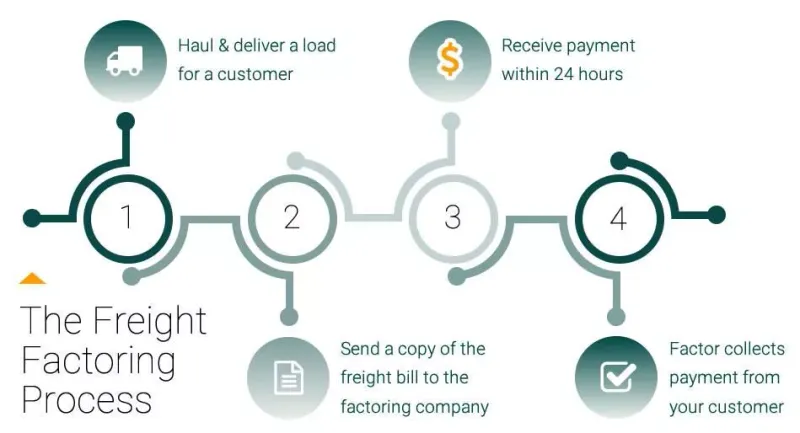
The freight factoring process follows a consistent pattern for every load. Understanding each step helps you submit cleaner paperwork and get paid faster. For a deeper breakdown, see our how factoring works guide.
Deliver the Load
Pick up and deliver the freight as normal. Get the bill of lading signed at pickup and proof of delivery signed at the receiver. Clean, signed documents are essential — a factoring company will not advance on a load without them.
Submit Paperwork to the Factoring Company
Upload or email your rate confirmation, signed BOL, and signed POD to your factoring company. Most freight factoring companies have apps or online portals that let you submit from your phone immediately after delivery. The faster you submit, the faster you get paid. Need a clean, professional invoice to submit? Use our free freight invoice maker to generate one in minutes.
Factoring Company Verifies and Advances
The factoring company reviews your documents, verifies the load with the broker, and checks the broker's credit. Once verified, they advance 90-97% of the invoice value to your bank account. This typically happens within 24 hours — some companies offer same-day or 2-hour funding for an additional fee.
Factoring Company Collects from the Broker
The factoring company sends the invoice to the broker or shipper and collects payment on the normal terms — typically 30 to 45 days. You are out of the collection loop entirely. The factoring company handles follow-ups, payment processing, and any collection issues.
Receive the Reserve (Remaining Balance)
Once the broker pays the factoring company, you receive the remaining balance (the reserve holdback) minus the factoring fee. If the advance was 92% and the fee is 3%, you receive the remaining 5% once the broker pays. The 3% is the factoring company's fee for the service.
Submit Paperwork the Same Day You Deliver
Freight Factoring Rates
Freight factoring rates typically range from 1% to 5% of the invoice value. Where you fall in that range depends on several factors. For a detailed breakdown with 2026-specific data, see our freight factoring rates 2026 guide.
| Factor | Impact on Rate | Typical Range |
|---|---|---|
| Monthly volume | Higher volume = lower rate | 1.5-4% |
| Broker credit quality | Stronger broker credit = lower rate | 1-3.5% |
| Recourse type | Non-recourse costs 0.5-1% more | +0.5-1% |
| Contract type | Full turnover = lower; spot = higher | +0.5-1% |
| Invoice size | Larger invoices may get lower rates | 1-5% |
The base rate is only part of the cost. Many factoring companies charge additional fees for ACH transfers, fuel advances, same-day funding, reserve holdbacks, and monthly minimums. These hidden fees can add 0.5-2% to your effective cost. For the full breakdown of fees to watch for, see our factoring hidden fees guide.
Compare Total Cost, Not Just the Rate
Recourse vs Non-Recourse Freight Factoring
This is the single most important decision you make when choosing a factoring arrangement. It determines who takes the financial loss when a broker fails to pay. For the full comparison, see our recourse vs non-recourse factoring guide.
| Feature | Recourse | Non-Recourse |
|---|---|---|
| Who absorbs non-payment? | You (the carrier) | Factoring company |
| Typical rate | 1-3.5% | 2-5% |
| Protection scope | None | Bankruptcy/insolvency only (usually) |
| Best for | Carriers hauling for well-known brokers | Carriers working with unknown brokers |
Important: “non-recourse” does not mean the factoring company absorbs every type of non-payment. Most non-recourse agreements only cover non-payment due to the broker's bankruptcy or financial insolvency. If the broker disputes the invoice because of a freight claim, shortage, or service issue, you are still on the hook in most non-recourse contracts. Read the fine print carefully.
Invoice and Document Requirements
The speed and reliability of your factoring depends entirely on the quality of your paperwork. Factoring companies require specific documents to verify that the load was completed and the invoice is valid. For a complete application walkthrough, see our factoring application checklist.
Rate confirmation — The signed agreement between you and the broker showing the rate, pickup/delivery locations, dates, and terms. This establishes what you are owed.
Signed bill of lading (BOL) — The receipt issued at the point of pickup confirming the freight was received in a stated condition. Must be signed by the shipper and the driver.
Proof of delivery (POD) — Signed confirmation from the receiver that the freight was delivered. This is the most critical document — without a clean POD, most factoring companies will not advance funds.
Your invoice — Some factoring companies generate the invoice for you; others require you to submit your own. Either way, the invoice amount must match the rate confirmation exactly.
Take Photos of Every Document Before Leaving
How to Choose a Freight Factoring Company
Not all factoring companies are created equal. The wrong choice locks you into a contract with high fees, slow funding, and poor support. Here are the key criteria to evaluate. Be sure to also review our factoring mistakes to avoid guide and factoring contract terms guide before signing anything.
Total Cost (Not Just the Rate)
Request a complete fee schedule. Calculate what you would pay on a typical month of invoices including all fees — not just the headline factoring rate. The cheapest advertised rate often has the most hidden fees.
Funding Speed
How fast do they actually pay once you submit documents? Ask for their average funding time, not their best-case marketing number. Same-day funding should be available even if it costs extra.
Contract Flexibility
How long is the contract? Can you leave without a termination fee? Do they require full turnover or allow spot factoring? Avoid long-term contracts with large termination penalties — especially as a new carrier.
Trucking Industry Experience
Do they specialize in freight factoring or are they a general factoring company that takes trucking clients? Freight-specialized companies understand BOLs, rate confirmations, broker credit, and the pace of the industry.
Add-On Services
Do they offer fuel advances, fuel cards, free broker credit checks, or QuickPay options? These add-ons can provide genuine value — or be fee traps. Evaluate each on its own merits.
Ask for References from Carriers Your Size
Freight Factoring: Pros and Cons
Freight factoring solves a real problem — the gap between when you deliver a load and when you get paid. But it is not free, and it is not the right solution for every carrier. Here is an honest assessment:
Pros
- Immediate cash flow — Get paid within 24 hours instead of 30-90 days
- Easy approval — Based on broker credit, not yours; accessible to new carriers
- No debt — Factoring is selling an asset (your invoice), not borrowing money
- Broker credit checks — The factoring company vets brokers for you, reducing non-payment risk
- No collection hassle — The factoring company handles all payment follow-up
Cons
- Costs 1-5% per invoice — On a $200K/year operation, that is $2,000-$10,000 in fees
- Hidden fees — ACH fees, minimums, reserves, and termination penalties add up fast
- Contract lock-in — Some contracts are 6-12 months with expensive exit clauses
- UCC-1 filing — The factoring company files a lien on your receivables, complicating other financing
- Broker restrictions — The factoring company may decline invoices from certain brokers
For a detailed comparison of factoring against traditional financing, see our freight factoring vs bank loan guide. If you are comparing factoring to broker-offered quick payment, check our factoring vs QuickPay guide.
Who Uses Freight Factoring?
Freight factoring is most common among small carriers and owner-operators, but carriers of all sizes use it. Here are the groups that benefit most:
New carriers (first 1-2 years) — Cash reserves are thin, operating costs are immediate, and brokers pay on 30-45 day terms. Factoring bridges the gap between expenses and revenue. An estimated 70% of new carriers use factoring in their first year. See our factoring for new carriers guide.
Owner-operators — Solo operators typically have the least cash reserves and the highest sensitivity to payment delays. A single 45-day payment cycle can create a cash crunch that makes it hard to cover fuel, insurance, and truck payments.
Small fleets (2-10 trucks) — Managing cash flow across multiple trucks multiplies the challenge. Factoring gives fleet operators predictable funding to cover driver pay, fuel, and maintenance across the fleet. See our freight factoring for small fleets guide.
Rapidly growing carriers — Growth costs money: more trucks, more drivers, more fuel, more insurance. Revenue follows 30-90 days behind expenses. Factoring funds that growth without taking on debt or giving up equity.
Large carriers with strong cash reserves and established credit lines are less likely to need factoring because they can absorb the payment delay. But even some mid-size carriers factor selectively — for example, factoring invoices from slow-paying brokers while collecting directly from fast-paying ones.
How Our Dispatch Team Supports Factoring
At O Trucking LLC, we work with carriers who factor and carriers who do not. Either way, clean paperwork and verified brokers are the foundation of getting paid:
Broker credit verification before booking
Before dispatching a load, we check the broker's credit rating and payment history. This protects carriers who factor by ensuring the factoring company will accept the invoice, and it protects non-factoring carriers from brokers who pay late or not at all.
Clean documentation on every load
We verify that rate confirmations are signed and complete before pickup, and we follow up on PODs and BOLs after delivery. Clean documents mean faster factoring funding. Incomplete or inconsistent paperwork is the number one reason factoring payments get delayed.
Payment tracking and follow-up
For carriers who collect directly (without factoring), we track invoice aging and follow up on overdue payments. For carriers who factor, we coordinate with the factoring company to resolve any document or billing issues that could delay the advance.
Freight Factoring FAQ
Common questions about freight factoring, rates, requirements, and choosing a factoring company
How does freight factoring differ from regular factoring?
Freight factoring is a specialized form of invoice factoring built specifically for the trucking industry. Regular factoring works with invoices from any industry. Freight factoring companies understand rate confirmations, bills of lading, proof of delivery documents, and the credit profiles of freight brokers. They also offer trucking-specific add-ons like fuel advances, fuel cards, and integration with load boards. A general factoring company may not understand trucking documents or know how to verify broker creditworthiness.
What documents do I need to factor a freight invoice?
To factor a freight invoice you typically need three documents: (1) the signed rate confirmation showing the agreed rate and load details, (2) the signed bill of lading (BOL) confirming pickup, and (3) signed proof of delivery (POD) confirming the load was delivered. Some factoring companies also require you to submit your own invoice. The cleaner and more complete your paperwork, the faster you get paid. Missing signatures, unclear PODs, or discrepancies between documents cause delays.
Can I factor invoices from any broker or shipper?
Most factoring companies run a credit check on each broker or shipper before advancing funds on their invoices. If the broker has poor credit or a history of slow payment, the factoring company may decline that specific invoice or charge a higher rate. Some factoring companies maintain a list of approved brokers they will factor. This is actually a benefit — it protects you from hauling loads for brokers who may not pay. Ask your factoring company to check a broker before you accept the load.
What is the difference between recourse and non-recourse freight factoring?
With recourse factoring, if the broker or shipper fails to pay the invoice, you owe the money back to the factoring company. With non-recourse factoring, the factoring company absorbs the loss — but typically only in cases of broker bankruptcy or insolvency, not payment disputes or freight claims. Non-recourse factoring costs 0.5-1% more per invoice. Most carriers start with recourse factoring for the lower rate and switch to non-recourse once they understand which brokers carry higher risk.
How much does freight factoring cost in 2026?
Freight factoring rates in 2026 typically range from 1% to 5% of the invoice value. Most carriers pay between 2% and 3.5%. The rate depends on your monthly volume (higher volume = lower rate), the creditworthiness of the brokers you haul for, whether you choose recourse or non-recourse, and your contract terms. Beyond the base rate, watch for additional fees: ACH transfer fees ($2-5 per transaction), reserve holdbacks (5-10%), monthly minimums, and fuel advance fees. See our freight factoring rates guide for a complete breakdown.
Do I have to factor all of my invoices?
It depends on your contract type. Full-turnover (or all-in) contracts require you to factor every invoice through that company. Spot factoring (also called select factoring) lets you choose which invoices to factor on a per-load basis. Spot factoring typically costs 0.5-1% more per invoice but gives you the flexibility to factor only when you need cash quickly and collect directly on invoices where you can wait for payment.
Can new carriers with no operating history get approved for freight factoring?
Yes. Freight factoring is one of the easiest forms of financing for new carriers to access because approval is based primarily on the creditworthiness of the brokers you haul for, not your own credit history or time in business. Many factoring companies actively market to new authority carriers. Some will approve you the same week you get your MC authority activated. This makes factoring the most common cash flow tool for carriers in their first year of operations.
Need Dispatch Support With Clean Paperwork?
Our dispatch team verifies broker credit before booking and ensures every load has clean, complete documentation — so your factoring company pays you fast and without delays.